
Martis bracelets: a thread connecting us to ancient Eleusis or a pan-Balkan spring tradition?
Make it stand out
Whatever it is, the way you tell your story online can make all the difference.
Are marketing claims connecting them to Eleusis a fake-out?
If you’re on Greek and Balkan Instagram, like, at all, you’ve likely seen many small shops selling the Martis or Martakia, aka March bracelets (the akia is diminutive, how cute!). And if you’re a Greek in Greece, you know their popularity has had a resurgence to the wild extent that this simple, handmade craft bracelet is now sold at Jumbo (If unfamiliar, Jumbo is a Greek megastore, think Walmart meets Shein IRL, with a labyrinthine layout).
To say they’re everywhere would be an understatement; observationally, they've made their way into diaspora culture en masse more recently. For example, my mother, whose parents were both Greek (off the boat, as they say), never had this tradition. In the watered-down diaspora narrative, we often lose sight of the more regional elements of “Greek” culture, as they get muddled together. However, a tradition practiced in, say, Epirus may never have reached the southern Peloponnese or the Cyclades, and vice versa.
When it comes to the Martis, the marketing typically includes their historic significance. We’ve seen many narratives, some true, some questionable. But the prevailing facts are these:
-The tradition is overall more Balkan and seems to originate in modern-day Bulgaria and northern Greece. In Bulgaria, it’s called a Martenitsa, in Romania, a Mărțișor.
-It heralds the beginning of spring.
-Red thread is typically used, often interwoven with white. Note that red is considered a protective color in many Balkan traditions.
-There is one literal interpretation that the red protects the skin from burning in the newfound spring sun. However, the bracelet is also seen as a talisman, of sorts.
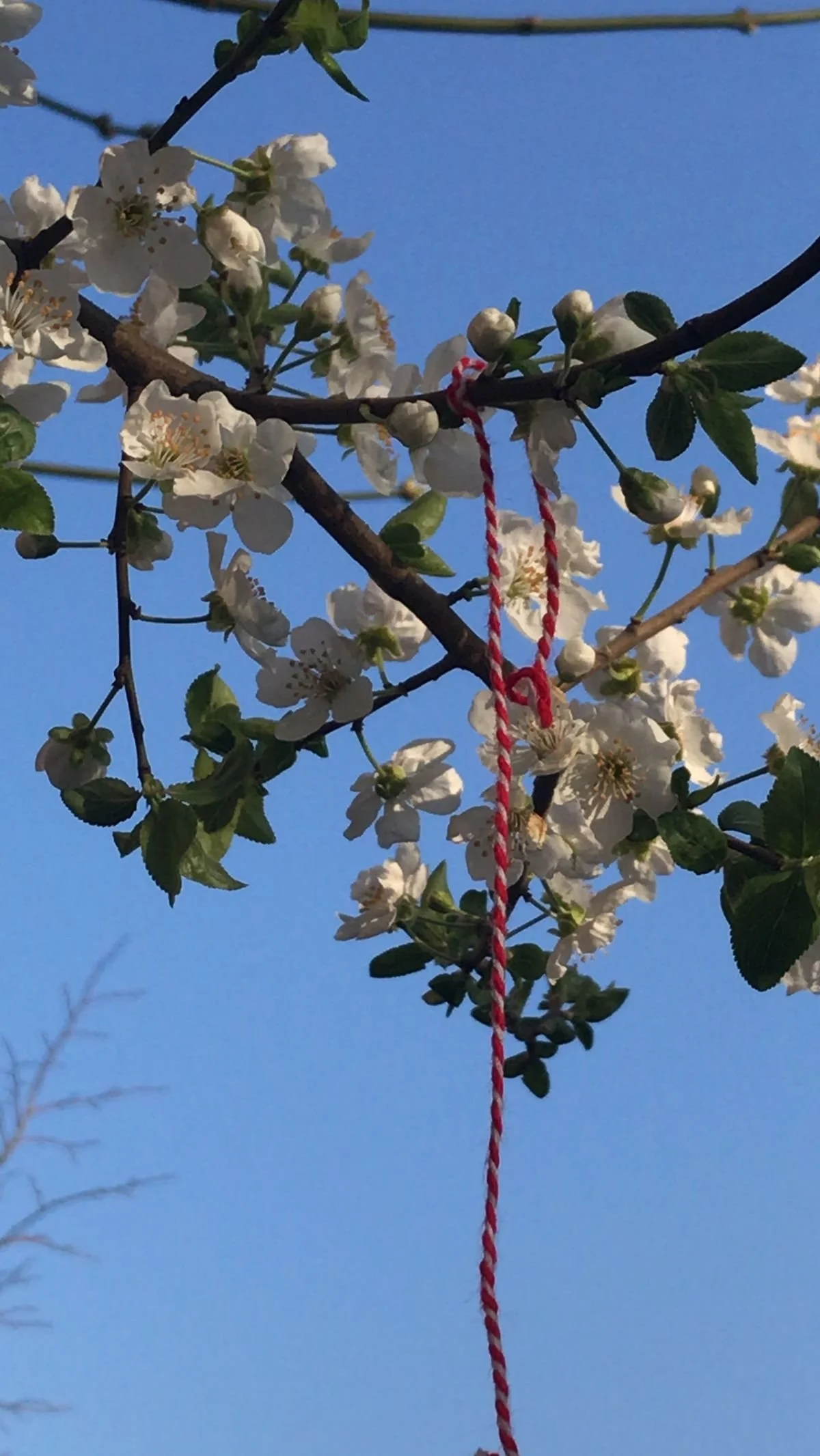
-When the month of March ends or when it falls off, the tradition holds that you complete the tradition by tying the bracelet to a tree, which is supposed to help said trees flourish and bear fruit. It all comes full circle this way, from nature to human and back to nature.
We forget how our ancestors’ well-being (aka survival) was connected to simple things like access to water and a good harvest. And there was no SPF 50+.
Did the bracelets originate at the Mysteries of Eleusis?
Now, here we come to the marketing fodder dropped by countless blogs, Greek news outlets, and retailers as historic fact: that this tradition began with the Mysteries of Eleusis. The Eleusinian Mysteries were one of the most important ancient religious spiritual rites of Greek antiquity, and they’ve received hype in recent years thanks to theories that initiates drank a sort of psychedelic substance (simplified here for brevity’s sake). Said theory reached the likes of the Joe Rogan podcast, and now we see headlines sharing that ancient Greek priestesses were administering ergot tea (see similar theories for the hysteria of the Salem witch trials), etc. We are not debating this today, rather sharing how Eleusis has become trendy again, and how modern practices are often purported to have ancient origins.
And so, now when you Google the martis bracelets or go to purchase one, it’s often shared that they date back to the mysteries of Eleusis. In the Greek urge to attribute many things to our great, ancient culture, sometimes we hit, and sometimes we really, really miss.
As an archaeologist (S) and cultural historian (K), we’re taking a look at whether that theory holds credence. And it looks like, well, it doesn’t.
Here are some of the facts:
We know a lot about Eleusis, not just the Mysteries of Demeter and Kore that took place there (and in Athens, and on the road in between), but also life in this town the rest of the year, from the work of archaeologists over the last century.
The Mysteries are obviously intriguing to scholars and the general public alike—who doesn’t love a mystery? Because the cult was so long-lasting, we do have some ancient textual sources that mention it, but they are limited in what details they share. The core rites of the ceremony were supposed to be secret, and people mostly took that seriously (we know something was shown or revealed to initiates within the Telesterion—the unique temple built to hold a crowd—but not what exactly, but possibly…. wheat). This limits our ability to reconstruct what actually happened. For instance, any mention of rituals in Athenian plays should come with a warning to remember the existence of artistic license—although the 6th c BCE playwright Aeschylus, who grew up in Eleusis and worked in Athens, apparently got in some hot water for getting too close to revealing secrets of the Mysteries in his plays. Pausanias, the 2nd-century CE travel-writer who had a special interest in cults of Demeter, also describes many of the rituals and monuments between Athens and Eleusis that were part of the festival procession, but he basically stops at the sanctuary gates because, he says, he does not know who is reading his account—they may be uninitiated.
Perhaps understandably, but still frustratingly, many popular accounts of these religious practices drop the nuance in favor of the allure of rites that were secret, and must have involved drug use rather than true faith, and that also persist into our modern customs. Eleusis becomes both exotic and familiar.
Firstly, most of these countless web articles mention the kroke, a saffron-colored bracelet (crocus flower → saffron).
Everyone references and repeats:
G. Mylonas, Eleusis and the Eleusinian Mysteries, 1961, p255: who wrote:
As soon as the initiates had crossed the bridge, a special and interesting event would occur. It was known as the krokosis, from the legendary Krokos, the first dweller of the territory, whose descendants had the privilege of tying a woolen kroke, a saffron-colored ribbon, around the right hand and the left leg of each of the mystai. What the meaning of this rite was, we do not know, but perhaps it protected the initiates against evil spirits. Deubner maintained that this rite, the krokosis, was performed in Athens between Boedromion 15 and 19, to avoid delay which would naturally result if held on the road during the pompe. However, the rite would offer to the initiates the chance to rest; it would serve to fill the time until sunset, and then the pompe could continue its way by torch light.
The issue: Muddled citations. In addition, this festival took place in the fall (Boedromion). There were also “Lesser Mysteries” which took place in the spring, but these are not connected (as far as I can tell) to the kroke tradition. Thus making the connection to the Martis, which is 100% a spring thing, pretty weak.
Who did Mylonas cite? Well, no one is ancient. Firstly, we have Foucart in 1914, who cited Bekker, a German classical philologist in 1814 from his “Rhetorical Words.”

In the “Rhetorical Words” section, P273:
Bekker says the mystai put the krokon on their ankles. But where did he get this information? As always, we must dig deeper.
Next, we look to ancient sources that mention any sort of bracelet or ribbon that might be Martis’ ancestor:
Here, once again, we find mentions of the kroke, but nothing to fully tie the threads of our bracelet mystery together. We have chest ribbons and, once again, our kroke. But can we connect this “saffron” thread to the red-and-white Martis, truly? Once again, we’re not convinced.
In 1st–2nd c CE, Plutarch mentions “the fillets with which they entwine the mystic chests were dyed, instead of purple they showed a sallow and deathly colour.” Some of the blogs mention this connection, but it seems like a stretch… in addition, chests?
The oldest mention of the mystai wearing the krokos comes from Photius, a 9th c CE Ecumenical Patriarch of Constantinople and scholar who compiled a lexicon—a catalog of interesting and unusual Greek words. Mind you, this is about 400 years after the Mysteries ceased.
He says a string is tied on the right hand and left foot. But where HE got this from, we sadly have no idea.
Here is the passage:
Κροκοῦν: οἱ μύσται ὡς φασὶ κρόκη τὴν δεξιὰν χεῖρα καὶ τὸν πόδα ἀναδοῦνται· καὶ λέγεται τοῦτο κρο κοῦν· οἱ δὲ ὅτι ἐνίοτε κρόκωι καθαίρονται.
Krokoun: they say the initiates bind their right hand and foot with a saffron thread; and this is called krokoun; others say that sometimes they are purified with saffron.
Where does this leave us? Many mentions of a saffron bracelet by later authors, but no solid ancient evidence of a link between Eleusinian initiates and the practice. The disconnect between Photius and the ancient mysteries is notable—he may be citing older sources that we just don’t have anymore.
It’s also worth noting that none of these mentions of the kroke go on to connect it to any traditions post-Eleusis, whose mysteries ceased in 392 CE with the bans on pagan worship implemented by the (Christian) Roman emperor Theodosius I.. As Christianity overtook Greece and the Balkans, is it possible this tradition of the kroke would have continued, specifically from Eleusis? Or did our beloved Martis evolve out of something else entirely?
An alternative theory:
Seems like the internet has seized onto Eleusinian because that’s better known, but IF it’s from an ancient festival, then it seems more likely to be from the Anthesteria, a popular spring festival in Athens where children were given protective bracelets (among other things, such as wine, lol). Other scholars (below) have made this connection/assumption, which seems more plausible. Archaeologists have found many of the mini jugs given to kids for their first wine, which often portray children wearing bracelets, anklets, and amulets strung on thread and worn across the chest.
In addition, Anthesteria falls during late February and early March (close to modern-day Apokries). This festival celebrating Dionysos and the newly matured wine seems much more likely to have a strong thread (pun intended) to the Martis worn today.
FINALLY, we zoom out of “Greece” and Hellenes… which is, perhaps, where we could have started and ended the conversation. As mentioned, the martis is a very pan-Balkan tradition, and each country has its own origin explanations. We aren’t getting into those here, but encourage you to dig for further nerdery!
FURTHER READING:
2019 NYT article with a nice overview: Athens in Pieces: What Really Happened at Eleusis? - The New York Times
New book on Eleusis and surrounding area, Shannon has a chapter here: Beyond Mysteries: the Local World of Ancient Eleusis, H. Beck et al. 2025
Coming of age in ancient Greece : images of childhood from the classical past : J. Neils et al. 2003
Polytheism and Society at Athens, R. Parker 2007
Dr. Shannon M. Dunn is an archaeologist who primarily studies the relationships between religious practices and the natural landscape in pre-Roman Greece, with a focus on sanctuaries in coastal and border areas of the Peloponnese. She has excavated and surveyed throughout the eastern Mediterranean, and in the summer can typically be found studying survey pottery in the Mani Peninsula. Her publications include the exhibition volume Hippos: The Horse in Ancient Athens and a book chapter on the cult of Poseidon at Eleusis (in Beck 2025 ^). She also runs the Instagram account @onestarchaeology, which shares real 1-star Google reviews of archaeological sites.